Powered By Blogger

Monday, June 20, 2011

The Benedict Arnold/Dr Benjamin Church Jr Confrontation - Part Two

Late 19th century view of the capture of Fort Ticonderoga
  Down through the years, the capture of Fort Ticonderoga has been treated as an iconic event when, in fact,  the reality of what actually happened is nowhere near the legends that have surrounded it. What really happened in the early morning hours of May 10th, 1775  was that Benedict Arnold and Ethan Allen, with perhaps around eighty of the Green Mountain Boys, swept past a sleeping  British sentry, overpowered a second guard and swept into the fort before the British even knew what was happening. Within ten minutes, the fort had been taken, the British garrison and about forty dependents captured, and four hundred Vermonters swarmed into the fort. Unfortunately, one of the first discoveries after capture of the fort was a a wardroom cellar underneath the officers' quarters housing ninety gallons of rum, enough liquor to keep the Green Mountain Boys drunk for three days. Allen made arrangements to send the prisoners back to Connecticut just before his boys felt compelled to celebrate their "victory" by getting roaring drink and plundering everything in the fort.

   Arnold, trapped in this drunken mess, attempted to assert his command authority. Without getting into all of the intricate details of the struggle between Arnold and Allen over who had command authority before the assault on Ticonderoga, suffice it to say that an uneasy compromise of a type of joint command prevailed before the assault. The Green Mountain Boys were not about to accept a commander that they had not elected, especially someone like Arnold, resplendent in a red uniform, who reminded them of the British officers they so despised. Not to mention that Arnold was a Connecticut citizen who held a commission in the Massachusetts militia, and that Connecticut had its own officers present with instructions to take the fort, compounded by the fact that they all were committing acts of rebellion and treason in another colony, New York, whose colonial leaders believed that Allen and his Green Mountain Boys were brigands and land thieves. A gigantic mess, but one that could be expected  now that separate and distinct colonies, with no real central authority, other than a fledgling Continental Congress still trying to come to grips with its own authority, had suddenly erupted into open rebellion against the crown.

   Arnold was thwarted in his attempt to assert control over the Green Mountain Boys' orgy of drunkenness and looting by Allen who took umbrage at anyone attempting to stop "his boys" from their "right to plunder". One wonders if Allen could have stopped them, even if he had wanted to do so. To underscore his authority, Allen had William Mott issue him a Connecticut commission so that he could keep command by authority of Connecticut ; when Arnold waived his Massachusetts commission in Allen's face, Allen could waive his Connecticut commission in Arnold's face.

   At one point, Arnold was faced with a looter who, sick and tired of Arnold's attempts to restore order and threatening the looters with military justice, leveled his musket at Arnold's chest and cocked it, threatening to kill Arnold if he continued to attempt to interfere with the looting. Arnold stared the man down and, after a few minutes, the man lowered his musket and went about his looting.

   When Silas Deane's brother arrived at the fort to assess the situation, he reported back to Connecticut that there was a war within a war at Ticonderoga. Ethan Allen and his land speculating mountain men were persecuting New Yorkers now in their power and were planning to hold the area and force their land claims on New York. Disgusted, Arnold confined himself to the officers quarters waiting arrival of his recruits from Western Massachusetts. He continued to write reports to his patron Dr Warren and the Massachusetts Provincial Congress.

   Arnold, for all his skills, was politically naive. As a popular leader in New Haven, the successful and wealthy Arnold, had relied on confrontation and intimidation to achieved his purposes. He was a neophyte in the realm of political debate and backroom politics. Within twenty four hours of taking Ticonderoga, Ethan Allen taught him how to play politics for private advantage and exposed Arnold as a naive and fumbling politician. So undeft was Arnold that, by the end of June 1775, he had nearly destroyed his prospects for continuing his military career.

   While Arnold stalked the fort and fired off letters to Warren, Allen was busy writing his account of the taking of Ticonderoga. Allen's accounts varied from day to day and for four years he continued to embellish them. In his first account to the Massachusetts Congress, Allen took sole credit for the capture of Ticonderoga, did not mention Arnold by name, but said that his friend and crony James Easton had led Arnold's fifty Massachusetts troops "with great zeal and fortitude. (Arnold later charged that Easton had cowered down by the boats along the lake, pretending to dry his musket until the attack was over.) Allen also praised his attorney friend, John Brown, who was well known in Massachusetts politics, stating that he had been involved in the attack when he had actually been in a tavern across the lake during it. The two men mentioned by Allen held personal grudges against Arnold. John Brown had worked in Arnold's cousin Oliver's law office in Rhode Island and was bitter towards the Arnold family after being fired. Tavern keeper Easton, like Brown, was a self-styled militia colonel who thought that he, not Arnold, should have been commissioned to lead the Massachusetts troops and now was working hard to discredit Arnold and gain Arnold's colonelcy.

  Allen continued to write letters to various officials and individuals in Massachusetts and Connecticut, embellishing and changing his account of the campaign to capture Ticonderoga and the other forts to serve his and his allies purposes.

   Arnold wrote to Cambridge with his final report only after learning of Allen and his friends' duplicity. To his friend and patron, Dr Warren, Arnold wrote:
Beg leave to observe, I have had intimation given me, that some persons had determined to apply to you and the provincial Congress, to injure me in your esteem by misrepresenting matters of fact. I know of no other motive they can have only my refusing them commission from the very simple reason that I did not think them qualified. However, gentlemen, I have the satisfaction of imagining I am employed by gentlemen of so much candor that my conduct will not be condemned until I have the opportunity of being heard.
  To add insult to injury, on May 12th, 1775, about fifty Green Mountain Boys under Seth Warner, most of whom had missed the Ticonderoga assault, seized the British fort at Crown Point. Together, Crown Point and Ticonderoga yielded 201 artillery pieces, some 100 of which were in usable condition. Eventually, fifty-seven of these pieces, the heaviest of which weighed a ton, were manhandled across the Berkshires, then the width of Massachusetts before being set up on Dorchester Heights overlooking Boston from the South. It was the placement of these guns, which threatened the British fleet in Boston harbor that forced the British to evacuate the city in mid-March 1776.

Crown Point
  
     All of this rancor and manuvering by Ethan Allen, Benedict Arnold, James Easton, etc would play a part when Arnold returned to Cambridge and tried to deal with the effcts of all of this. It was then he would run into Dr Church.

To be Continued.

Friday, June 10, 2011

The Benedict Arnold/Dr Benjamin Church Jr Confrontation- Part One

  Surprising as it is to many people, two of Revolutionary War America's  most notorious individuals, Benedict Arnold and Dr Benjamin Church, Jr., did meet and had a very brief, but troubled relationship. The circumstances surrounding their interactions are a little complicated and we need to set the scene.

Benedict Arnold


  On April 19th, 1775, as the British marched on Concord, couriers sent word of the outbreak of hostilities throughout New England and asked for support. When word reached New Haven, Connecticutt, the town leaders voted not to send any aid. However,  34 year old Benedict Arnold, ship's captain and prosperous merchant, defied them, mustered the Governor's 2nd Company of Footguards, all sixty three of them, of which he was Captain, seized the town's gunpowder and marched to the relief of Massachusetts. Arnold had been voted Captain of the Footguards by his men despite his inexperience in the art of war; but given his personal wealth ( much of which was probably the result of smuggling), his reputation as a staunch Patriot, and his high standing among New Haven's working class, he was the logical choice. Arnold had  been smitten with the "military bug" and had run away from home three times as a boy to enlist to fight in the French and Indian War.

   On the march from New Haven to the outskirts of Boston, Arnold had a brief but fateful meeting with Colonel Samuel Holden Parsons, a Connecticut Patriot who was returning from Cambridge to begin recruiting troops in Hartford. Parsons mentioned to Arnold that the Patriot force in Cambridge suffered from a shortage of a number of things, but especially cannon and other ordnance pieces. Obviously, this put the Patriots forces at a great disadvantage relative to the British, who were not only well supplied with artillery but could put the cannon of the British fleet, moored in Boston Harbor, to bear. Arnold, who had spent some time in northern New York during the French and Indian War, responded with an account of the state of Fort Ticonderoga and mentioned that the fort had a large number of cannon. This somewhat innocent exchange would prove to the source of some nasty problems for the Patriots after Arnold and Parsons, each going their separate ways, each decided that Fort Ticonderoga must be taken and the artillery pieces it contained seized and put to use for the Patriot cause.


   For over twenty years, Benedict Arnold had been traveling all over colonial America from Canada to the southern Caribbean by foot, horseback, stagecoach, and ship learning its harbors, roads and fortifications. Arnold pointed out to Parsons that in two forts in particular, Fort Ticonderoga and Crown Point at the southern tip of Lake Champlain, there were hundreds of good cannon for the taking. A few hundred men could overpower the depleted guard forces in these forts, seize the artillery and then drag the guns to Boston for use against the British.
Dr Joseph Warren by John Singleton Copley

   Eight days after Lexington/Concord, Arnold and his well-dressed, resplendent Footguards strutted into the ragtag American camp at Cambridge cutting such a figure that they were immediately singled out to escort the body of a British officer mortally wounded at Concord through the lines to British HQs in Boston. The footguards uniforms were:

   "A scarlet coat of common length, the lapels, cuffs and collars of buff and trimmed with plain silver wash buttons, white linen vest, breeches and stockings, black half leggins and small, fashionable and narrow ruffled shirt." The coat was made with slide pockets but no flaps. Later, cartridge boxes, hats, cockades were adopted. The hair was clubbed behind, the side locks braided and powdered. The drummers were dressed in buff faced with scarlet and the fifers in scarlet with buff collars and cuffs.

Artemus Ward by Charles Wilson Peale

   After his return from Boston, Arnold was introduced to the Massachusetts Committee of Safety on April 30th, 1775. The Committee members had been inundated with schemes to fight the British. Arnold had sought out Dr Joseph Warren, then the powerful Chairman of the Committee, and it appears the two men hit it off.  Dr Church was the second most powerful. Arnold was brought in to explain to the Committee the ruined condition of the two New York forts, their depleted garrisons, and usable artillery. Warren asked Arnold to prepare a written proposal., which he did.

          Gentlemen:
You have desired me to state the number of cannon, etc. at Ticonderoga. I have certain information that there are at Ticonderoga eight pieces of heavy cannon, twenty brass guns, from four to eighteen: pounders, and ten to twelve large mortars. At Skenesboro, on the south bay, there are three or four brass cannon. The Fort Ticonderoga is in a ruinous condition and has not more than fifty men at the most. There are a large number of small arms and considerable stores and a british sloop of seventy or eighty tons on the lake. The place could not hold out an hour against a vigorous onset.
   Two days later, the Massachusetts Committee of Safety sent a subcommittee, headed by Warren, to confer with Major General Artemus Ward, who was in command of the American troops surrounding Boston. Ward was easily persuaded of the viability of Arnold's plan and Warren and Ward struck a bargain. The Massachusetts Provincial Congress was to give Arnold L100 in cash, and Ward would supply him with ten horses, two hundred pounds of gunpowder, two hundred pounds of lead, and a thousand flints - all he said he could spare. Because these supplies were so limited, Arnold was also authorized to draw on the financial credit of the Committee of Safety in obtaining "suitable provisions and stores for the army." Arnold was commissioned a Colonel in the Massachusetts Militia, appointed to a "secret service" and allowed to select two captains to assist him in recruiting up to four hundred soldiers. His orders were to take "possession of the cannons, mortars, stores, etc., upon the lake" and then return with  "serviceable" weaponry to Cambridge.

   It was Dr Benjamin Church, Jr. who signed Arnold's orders for the Committee of Safety. It appears that Dr Church had replaced Dr Warren as Chairman of the Committee in the early part of May.

   The next day, May 3rd, 1775, Arnold rode west with a few aides, totally abandoning his company of Connecticut Footguards. In addition to the men he and his aides would recruit in Western Massachusetts, Arnold planned on using Ethan Allen and his "Green Mountain Boys" in any attacks on British forts in northern New York.  Thus he  thought he would have  sufficient force to complete his mission.
Painting of Fort Ticonderoga as it may have appeared. The present Fort Ticonderoga has been reconstructed.

   Arnold, however, was not aware that Colonel Parsons had also been giving a lot of thought to the artillery at Fort Ticonderoga. After leaving Arnold, Parsons rushed into Hartford and contacted Silas Deane, a delegate to the Continental Congress from Connecticut, and convinced him of the merit of taking Ticonderoga as soon as possible. On no one's authority but their own, they drew L300 from the Provincial Treasury and picked captain Edward Mott to lead an expedition to capture Ticonderoga. They also found Heman Allen, Ethan Allen's younger brother, and sent him off to the New Hampshire Grants (Vermont) to enlist the services of his older brother and the Green Mountain Boys. Mott and his small raiding party started north on Saturday, April 29th, the very day Captain Arnold and his Footguards marched into Cambridge.

   It should be noted that Ethan Allen was born in Connecticutt in 1737 or 1738 and had lived there until 1770. His brother Heman operated a general store in Salisbury, Connecticutt so the family was well known in the state. At this time, the Allens, who held numerous land grants in Vermont, were in an ongoing struggle with New York State which also claimed title to the same lands. The Allens hoped that by involving the Green Mountain Boys in an attack against the King's property in New York, while acting the part of disinterested patriots, they could solidify their rights to their land. . On May 3rd, the same date that Arnold began his journey across Massachusetts, the Mott force, augmented by about fifty volunteers from Western Massachusetts,  made contact with Ethan Allen in Bennington, Vermont.

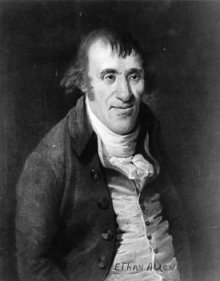
Ethan Allen


   Our story continues in Part Two.

Thursday, June 9, 2011

The Porter Decode

  I failed to note in my post on the Gerry/Porter Decode that at the October 3, 1775 Council of War  General George Washington convened at his headquarters in Cambridge to discuss the Church letter, he laid the Samuel West deciphered text before the generals he assembled to discuss the matter. No mention was made of the Gerry/Porter decoded letter. Attending that Council of War were Washington;  Major Generals -  Artemus Ward, Charles Lee, and Israel Putnam; Brigadier Generals -  Joseph Spencer, William Heath, John Sullivan, Nathaniel Greene, John Thomas; and, Adjutant General Horatio Gates.

Apropos of nothing, Nathaniel Greene, who went on to win much acclaim, was a personal favorite of Washington as was his vivacious wife, Caty, who was one of Washington's favorite dancing partners. Caty was also very close to Martha.

Nathaniel Greene of Rhode Island